Agentic Customer Care —
Glass × Adora AI
Molly Group grew through acquisitions — billing, CRM and digital products, each built by a different team. We shaped Molly Glass into one centralised customer-care workspace, orchestrated in layers, and brought in Adora, an AI that listens to every call and points agents straight to the answer — progressively reducing their cognitive load.
AI-Assisted Resolution
Down from up to 15 min
Actions in 1–2 Clicks
Front-office tasks
Operator Rating
Lowest score 4/5
Checks Re-distributed
High-bill work instruction
Outcome figures as reported by Molly leadership and operator feedback during the Glass rollout.
Adora AI
It Listens to Every Call —
And Takes the Agent Straight to the Answer
The moment an agent picks up, Adora starts listening. It picks out keywords from the conversation, turns them into insight cards, and each card deep-links into the exact part of Glass — billing, usage or customer insights — so the agent never has to go looking.
Live call
Adora listeningAdora
Tap an insightBill compare
Dec · Estimated
$192.40
Mar · Actual
$347.18
Illustrative re-creation of the interaction model — data mirrors the Glass v2 concept screens.
Listen
Voice-to-text from the moment the call connects.
Detect
Trigger words like “high bill”, “estimated”, “concession”.
Explain
Insight cards with the data point behind the cause.
Navigate
One tap opens the right section inside Glass.
The Ecosystem
Many Acquisitions, Many Systems —
One Platform, Orchestrated in Layers
Molly Billing, Molly Acquire, Molly Customer and Molly Digital each arrived with their own stack, brand colour and patterns. Rather than replace them, the strategy was to orchestrate them: systems of record at the bottom, shared services in the middle, Glass as the single workspace — and Adora as the intelligence on top.
Molly Billing
Multi-utility billing
Molly Acquire
Sales & onboarding
Molly Customer
Front & back office CX
Molly Digital
Self-service & insights
Each acquisition keeps its own platform. They stay the source of truth for accounts, invoices and usage — we orchestrate them rather than replace them.
Exposes account, billing and usage data to shared services
- Molly CIS · Core
- Orion · Engage · EOS
- Genesys telephony
- Client payment portals
Layers build bottom-up: each one feeds the next
The Challenge · Existing Pain Points
Agents Had All the Data —
Just Not the Right Data at the Right Time
“Systems have all the things, it's just not user friendly.” Generalist agents were juggling telephony, multiple CRMs and payment portals mid-call — with 500+ work instructions to remember and a customer waiting on the line.
Through Sam's eyes
Before Glass + AdoraOne high-bill call, start to finish
Meet Sam, a customer-care agent
Follow one real high-bill call, before Glass + Adora existed.
Fragmented Toolset
Genesys for calls, Core, Orion and Engage for customer data, client payment portals, and a separate tab just to check one-time passcodes before a call could progress.
4+ systems open per callHigh Bills = Longest Calls
The most common and slowest enquiry. Agents had to cross-check the usage tab, every previous invoice and payment history — data that was "not UX friendly at all".
Up to 15 min to resolve unassistedCritical Flags Hidden
Hardship, life support, family-violence PINs and active complaints were not surfaced up front — risking the wrong conversation with a vulnerable customer.
Compliance & duty-of-care riskGeneralists, Specialist Work
Agents are generalists, yet concessions, estimated reads and stepped tariffs need deep knowledge. Heavy training was required, and much functionality went unused.
500+ work instructionsAfter-Call Work
Notes lived in notepads or inconsistent tools. When a call ended, agents navigated around again to reconstruct what happened — then wrote the summary.
Time lost after every callThe Real Cost
Retailers take ~3 years to make a customer profitable. Every extra minute on the phone and every avoidable escalation erodes cost-to-serve — the metric Molly sells on.
Cost-to-serve is the productCognitive load — one high-bill call
Before — agent searches
After — Glass + Adora bring it to the agent
Discovery & Research
From the CTO to the Call Floor —
Aligning Vision With Reality
We ran structured interviews top-to-bottom: leadership for the north star, product and engineering for constraints, and the operations team for what actually happens on a call. Every conversation was synthesised into pain points and opportunity areas on a shared board.
CTO
North star, agentic AI vision, cost-to-serve
Product Manager — Glass
Reasons for calls, customer lifecycle, Adora role
Tech Lead & Design Lead
Token pipeline, React migration, design foundations
CS Team Lead + Agents
Day-to-day workflow, beta feedback, quick wins
Personas
Four lenses on one problem
Synthesised from the interviews above. Names and portraits are illustrative.
Daniel
Chief Technology Officer
- Owns the platform north star
- Accountable for cost-to-serve
- Final design sign-off
Keep the cognitive load simple. Make it intuitive, with less training needed.
Goals
- Make Glass the market-leading agent experience
- True agentic AI with Adora in the front office
- One tech stack and shared foundations
Frustrations
- Tech debt from legacy stored procedures
- Every acquired product looks and works differently
- Screens still feel busy despite quick actions
Needs from Glass + Adora
- A consistent design language across all products
- Adora doing more of the work, safely
- Faster agent onboarding
How they shaped the design
- Four-layer orchestration model
- Agentic Adora concept (V3)
- “One foundation” principle
Success looks like: Resolution time and cost-to-serve
Keep the cognitive load simple. Make it intuitive, with less training needed.
The biggest impact will be Adora — minimising agents’ talk time and looking for information.
Use Glass to expedite, then use Adora to get the next best action.
Synthesis — pain point to opportunity
Engagement plan
Holiday breakNov 2025
Dec 2025
Jan 2026
Information Architecture & Journey
Mapping the High-Bill Journey,
Then Redefining the IA Around It
We picked the hardest, most frequent scenario and mapped it end to end — then rebuilt the information architecture around it.
The old IA mirrored the systems.
The new IA mirrors how an agent thinks.
Organised by system
Agent stitches the story together, tab by tab.
Organised by the call
User flow — from ring to resolution
01Customer calls
Before
Agent answers with no context on screen.
With Glass + Adora
Glass opens alongside the call, ready to go.
Left · Who
Customer profile
- Verified identity & customer number
- DOB, contact, PIN / password
- Key dates: joined, last contact
- Payer rating
- Payment methods
Centre · What
Services by segment → drill into one
Overview
Plan, best offer, billing, info pills
Bill information
Overview · Load disagg · Usage
Timeline
Interactions, tasks, payments, filters
Bill compare
Any two bills, drop-down detail
Right · Help
Adora rail
- Live insights while call is active
- Ask Adora — natural language
- Control panel: tasks & new interaction
- Cross-sell only when relevant
The 14-step high-bill checklist
Mapped from the agent work instruction, then redistributed between agent and Adora
The Solution
Progressive, Not Big-Bang —
Evolving Glass Towards Agentic AI
Glass was already live with operators, so we couldn't start from zero. We evolved it in steps — each release reducing what the agent has to find, and increasing what Adora brings to them.
Everything on one screen — and that was the problem
Glass already aggregated the account, but profile, services, bill PDF, charts and cross-sell all competed at the same visual weight. Agents said quick actions helped, yet the screen was "still very busy" — and Adora was hidden behind a tab.
- Adora buried behind a right-panel tab
- Bill PDF and charts crowd the overview
- Vulnerability flags easy to miss
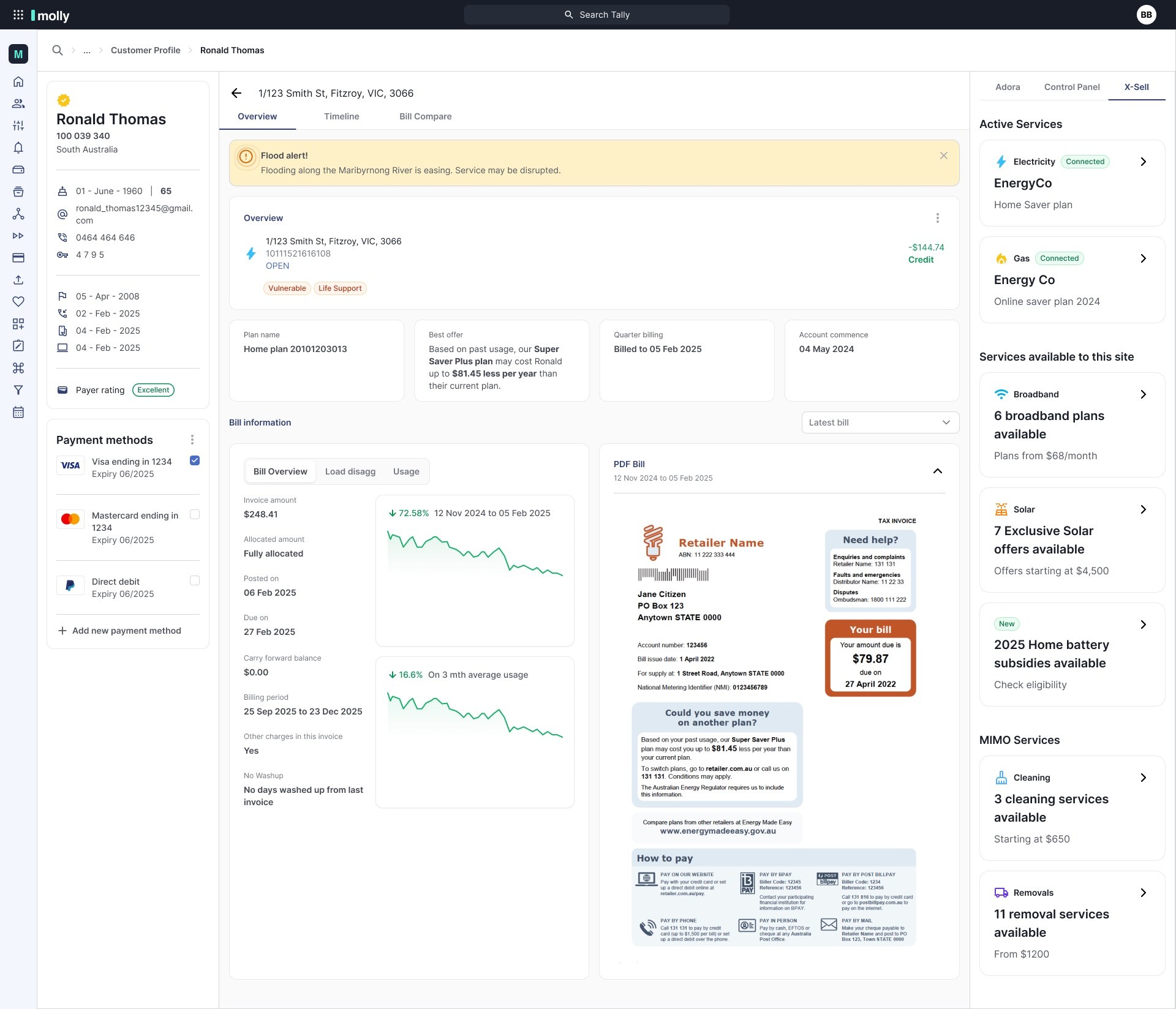
V1 · Glass today
Figma design · customer data is fictional
Progressive disclosure
Snapshot first — 9 of 10 enquiries should be solvable from the overview; detail on demand.
Right info, right time
Call state and keywords decide what surfaces — not a fixed dashboard.
Widgets that grow
Components start as small insights and expand as the agent moves down the funnel.
Role-based IA
Permissions hide what an agent can’t act on, reducing noise and escalations.
Human in the loop
Adora advises, the agent decides. Feedback on every card; clear “can make mistakes” cue.
One foundation
Shared tokens, type scale and light/dark themes so every Molly product can inherit Glass.
Impact
Less Searching, More Solving —
For Agents and the Business
Glass rolled out to a first wave of 50 operators, with Adora layered on top. Operators said it was the first time something had been built for them.
Resolution time — complex enquiry
As reported by Molly's CTO for Adora-assisted resolution.
80%
Front-office actions
Completed in 1–2 clicks
4.5/5
Operator rating
Lowest score 4/5
50
Operators
First rollout wave
1
Shared foundation
Tokens & components for all products
Reflection
Designing for AI Means Designing Trust
The hardest part wasn't the UI — it was deciding what Adora should do versus what the agent must own. Splitting the 14-step checklist into “Adora surfaces”, “Adora suggests” and “agent decides” gave the team a shared language for agentic features, and set the path for Adora to become the primary interface over time.
Stakeholder interviews
5+
Journey mapped end-to-end
High bill
Design iterations shown
3